Sunday, 17 February 2019

A Technical Challenge in the Kitchen

For many years now we have shared meals on a fairly regular basis with two sets of neighbours. We have an international theme, with each couple picking a random country - we wrote out the country slips after slightly too much wine, so some are very random indeed! - and providing either a starter, main course or dessert. Yesterday it was our turn to cook the main course and our country pick was Russia. One of our neighbours (technically now a former neighbour!) is currently eating fish but not meat, and the only suitable Russian fish dish I could find was this salmon coulibiac

I enjoy baking and I am a reasonably competent cook, but this was definitely out of my comfort zone! I am a big fan of the Great British Bake Off, and this was my equivalent of the technical challenge. Fortunately, unlike the contestants in Bake Off I had a picture of what the end result was supposed to look like, and a detailed recipe. Again, unlike Bake Off I did not have to make the puff pastry from scratch, which would have added a whole extra layer of difficulty. As it was it took me over an hour and a half to prepare. I was organised and got all my ingredients ready first. Instead of buying a large piece of salmon I bought six individual fillets as it worked out considerably cheaper. When it came to skinning them I may have regretted this a little. It was fiddly.


A salmon coulibiac is layers of seasoned rice mixed with hard boiled egg surrounding a salmon fillet, and wrapped in puff pastry - though I did see some recipes using filo pastry. The rice was first cooked with onion, garlic and fish stock, then seasoned with herbs and lemon before adding the chopped egg; meanwhile the salmon had to be part-baked.


Fortunately the pastry was pre-rolled, otherwise the chances of me getting it rolled to the exact size and thickness needed would have been slim! One sheet on the bottom, then a layer of the rice mixture, then the salmon ...


... and finally another layer of the rice, topped with a second sheet of pastry. I followed the instructions which said to make slits in the pastry, but I'm not entirely convinced this is how it was supposed to look. Fortunately it all held together.


And here is the finished pie. I was delighted with how it turned out, and it tasted very good. I served it with boiled new potatoes tossed in butter and dill, sautéed cabbage and green beans.


Part of the fun of these meals is that everyone has to try to guess the origin of the dishes they haven't cooked. This one came very close to defeating the guessers! They only made it to Russia with the help of a couple of clues. The starter was Moroccan (lamb kebabs, fish patties and chickpea salad) and the dessert Brazilian (a creamy mousse in a biscuit crumb case and a passion fruit cream). It always amazes us how our very eclectic country picks manage without fail to produce a three-course meal that works without any weird taste clashes. 

The combination of good food and good company always make it a fun evening. As our former neighbours now split their time between the UK and Spain it is especially good for us all to have the opportunity to catch up.

Sunday, 10 February 2019

A Little Bit of Summer: Oxford in the Sun

A week ago we had snow - just enough for youngest daughter's school to close for a snow day; now it is warmer, but wet and miserable. To remind myself that summer will be here soon(ish!) I am going to share a few sunny, summery photos from a trip to Oxford last June. I homeschooled my older daughters for several years when they were young, and was part of a lovely literature-loving support group with a mix of British and American families. Last year we held a reunion in Oxford, timed to allow us to visit the Tolkien exhibition at the Bodleian Library. People flew in from the US and Cyprus to join us and we had a wonderful weekend with much reminiscing and laughter.

I love this picture of colourful punts viewed from Magdalen Bridge. We didn't go punting this time, though I hired one with a friend and her daughter the previous year. Standing on a small platform at the end of a boat pushing it around with a pole is definitely challenging, particularly for someone like me with appalling balance. I was quite proud that I managed to manoeuvre us around the river for an hour without causing any accidents or falling in.


A slightly wonky picture of the Radcliffe Camera, which is one of the reading rooms of the Bodleian Library. 


We spent much of the morning at the Oxford Botanic Gardens. The friends I was with are both gardeners, whereas I have black thumbs and have yet to find a plant I can't kill. I could appreciate the beauty of the gardens, even if the finer points of the plants and how to grow them went right over my head!


The tower of Magdelen College chapel seen from the gardens.


And finally a view across to Christchurch - I think! I know Oxford pretty well, but can still be confused by a different angle. 


These pictures were all from our last day, which was when the sun finally came out. Oxford in the June sun has to be one of the world's most beautiful cities.

Monday, 4 February 2019

100 Books for 2018: 16 to 20

Book 16 - Ariel: A Literary Life of Jan Morris (Derek Johns)
After listening to Jan Morris' autobiographical account Conundrum I moved on to this biography by her long term literary agent, Derek Johns. I found it readable but mildly disappointing, though I now can't remember why!
*** 3 stars

Book 17 - The Troubadour's Tale (Ann Swinfen)
Still working through these medieval mysteries on my Kindle. While they very much stick to a formula I enjoyed both the characters and the setting, and felt she was able to keep up the pace and readability from one book to the next.
**** 4 stars

Book 18 - Betty: The Story of Betty MacDonald (Anne Wellman)
I stumbled across Betty MacDonald's account of her time in a tuberculosis sanatorium, The Plague and I, when I was still at school. Much later I read Mrs Piggle Wiggle to my daughters without having any inkling that the stories were by the same author. If I remember correctly, I had a free month's trial of Amazon's Kindle Unlimited, and this was one of the books I downloaded. Betty MacDonald's was a fascinating life, and I am not sure why I did not rate this higher - I think it would have been a 3.5 stars if Goodreads allowed for that.
*** 3 stars

Book 19 - How I Changed My Life in a Year (Shelley Wilson)
Another Kindle Unlimited book. The author decided to reboot her life by taking on a different challenge during each month over a year - mostly fairly obvious things like "lose weight", "get fit" or "do something creative". I am afraid it didn't inspire me.
** 2 stars

Book 20 - I Leap Over the Wall (Monica Baldwin)
Monica Baldwin, the niece of 1930s Prime Minister Stanley Baldwin, entered a convent at the age of twenty in 1914. Realising that she was utterly unsuited for the life she was dispensed from her vows in 1941 and left her enclosed life for a wartime world that was changed in almost every respect from the pre-First World War society she had left behind. This book tells the story of her struggle to adapt to her new secular life. She was by third party accounts a difficult character which can't have made this any easier. A fascinating read.
**** 4 stars

Wednesday, 30 January 2019

Last Year's Travels: Stockholm

Our first trip last year was to Sweden for a couple of days in Stockholm. This time it was just myself and M - our youngest stayed home with her sisters in charge. It was January. It was cold! Anyone with any sense was indoors ...


... or not! Even in January the main streets of the old town, Gamla Stan were busy 


I hadn't realised that Stockholm is built on a series of islands, so travelling anywhere meant crossing bridges.


It was the sort of weather where doing things that involved being indoors were most appealing. We visited the royal palace where we watched the changing of the guard before scuttling back into the warm.


An unexpected discovery was the Museum of Medieval Stockholm. A plan to build an underground car park for the Swedish parliament building had been abandoned when an archaeological dig discovered part of the medieval city wall and various other medieval sites. The car park site was instead used for a museum incorporating the archaeological finds and various full scale reconstructions.


On our second day we took a ferry to Djurgarden in search of more (indoor! warm!) museums.


In a complete change from the previous day we went for a bit of pop culture at the ABBA museum. We grew up during the ABBA years and M once saw them perform live, so we could hardly miss this one. 


For me the highlight of our trip was the Vasa museum. The Vasa warship sank in Stockholm on its maiden voyage in 1628 and was salvaged virtually intact in the early 1960s. It is now beautifully displayed in a purpose built museum. The photographs below don't do it justice - I couldn't find an angle that gives a true impression of its size.


Part of the carved stern of the Vasa ...


January may be a cold time to visit, but Stockholm does winter well. We didn't skate, but it was fun to watch. 


There were even some Christmassy reindeer brightening up the cold evening.


One small cautionary tale ... We knew that alcoholic drinks would be expensive in Sweden, so were surprised to find brandy on a restaurant menu at a very reasonable price. I wasn't tempted but M was, to two glasses. It was only when the bill arrived that we realised that the brandy was priced per 10ml, not by the glass. Oops!

Friday, 25 January 2019

100 Books for 2018: 11 to 15

Book 11 - Conundrum (Jan Morris) [Audio]
I first encountered Jan Morris when I was looking for a book about Trieste (there aren't many in English!). I loved her book as well as the city, and became intrigued by her own story as it was made casually clear in the book that when she first discovered Trieste it was as a young soldier named James.  The young James Morris was a choirboy at Christchurch Cathedral in Oxford. He joined the Army just after the Second World War and served in the Middle East in an intelligence role. After leaving the Army he became a journalist and was foreign correspondent for a series of major newspapers, including several years based in Egypt. He was part of Sir Edmund Hillary's Everest expedition and was the journalist who broke the news to the world that Everest had been conquered (in code, to maintain the scoop). He became a prolific travel writer, with books including classics about Oxford, Venice and New York. He married the love of his life and had five children, then in his forties he underwent sex change surgery. Forced by the law to divorce his beloved Elizabeth, they lived separately for a while, but continued to function as a family. When same-sex marriage was legalised in the UK they remarried, and are still together in their nineties. Conundrum is Jan's account of her experience of her gender (the conviction that she should be a girl came to her at the age of four, while sitting under her mother's piano stool), and her experiences before and after undergoing her physical change of sex. It was written in the 1970s, at a time when even the word  transgender was largely unknown. The story of one of the more extraordinary aspects of an extraordinary life, written by a master of her craft.
**** 4 stars

Book 12 - A Book of Silence (Sara Maitland)
Divorced and with her children grown up, author Sara Maitland found herself increasingly drawn to a life of silence, spending time in remote places with either no or minimal contact with other people. An "Anglo-Catholic socialist feminist" who converted to Roman Catholicism, this book explores her attempts to understand the meaning and spirituality of silence, and to work out the place of silence in her own life. Beautifully and thoughtfully written.
**** 4 stars

Book 13 - The Merchant's Tale (Ann Swinfen)
The fourth in Ann Swinfen's series set in 14th century Oxford. Like the first three, an enjoyable and easy read.
**** 4 stars

Book 14 - Terms and Conditions: Life in Girls' Boarding Schools 1939-1979 (Ysenda Maxtone Graham)
I was intrigued by this one as I was a boarding school girl myself in the late 60s and 70s. The book is based on interviews with former boarding school girls rather than any detailed research. Boarding schools and their pupils both varied widely, and the experience as a whole tended to depend on whether there was a good match between the individual and the school. Given the casual way in which some parents chose a school this could be very much a matter of luck! No startling insights, but quite readable.
*** 3 stars

Book 15 - The Secret Life of Bletchley Park (Sinclair McKay) [Audio]
We live very close to Bletchley Park, the centre of British code-breaking in the Second World War. The achievements at Bletchley are now thought to have contributed significantly to shortening the war. I have read quite a few books about the Park and its personnel, which included Alan Turing.  Listening to the audio version I had a feeling I had read this book a few years ago, but I can't remember for sure. Whatever, it is a good introduction to the story of Bletchley Park.
**** 4 stars

Monday, 21 January 2019

It's a Small World


Or, at least, a small continent. From our part of the UK it is incredibly easy to hop over to mainland Europe. The main budget airlines fly out of two London airports, one of which is under 30 minutes from us, and the other 75 minutes if there is no traffic. Over the past three years we have taken advantage of discounted flights to as much of Europe as we can manage. Last year we went on short breaks to Stockholm, Disneyland Paris, Normandy (by car and ferry), Gdansk, and Genoa. We also took a longer summer trip by rail across central Europe, visiting Switzerland, Austria and the Czech Republic. Smallest daughter also went on a school trip to Lille (France). This year we have already been to Disneyland Paris again, and have trips lined up to Rome, Genoa again and Greece.


This sounds incredibly decadent, but most of our flights have worked out at less than £50 return, and sometimes much less. Our middle daughter is spending the year studying at the University of Genoa in Italy, and she has truly mastered the art of the cheap flight - the lowest fare she has managed so far has been £4.25 to return to Italy after Christmas! She gets the benefit of a student discount and flying to a small and less popular airport, but this still boggles my mind - it costs as much for a two station, ten mile hop on the train. Popping home for the weekend is as easy as it was from her UK university. And when she is there she gets the view in the photo below from her apartment window. The other pictures in the post are also from our trip to visit her in Genoa last October.


Every time we travel, I realise again just how privileged we are to live at a time when the world has shrunk so that we are able to explore so many extraordinary places so easily. In a speech a couple of years ago Prime Minister Theresa May, pandering to the more insular faction of her party, said "If you believe you are a citizen of the world, you are a citizen of nowhere". In my view she couldn't be more wrong. I am a proud citizen of the UK (though admittedly rather less proud as we endure the embarrassing shambles that is Brexit), but also love being a citizen of Europe - I am not sure I can quite claim "citizen of the world" as I haven't ventured further afield yet. Even if Brexit means we lose the right to live, work and study anywhere in Europe, I don't intend to let it rob me of my identity as both British and European.

Sunday, 20 January 2019

Anglo-Saxon Kingdoms

The world divides into those people who will happily go to events alone, and those who need company. I fall into the former category, which is a good thing as I am interested in a fair few things that M would consider among the deeper levels of hell. One of these is medieval history.


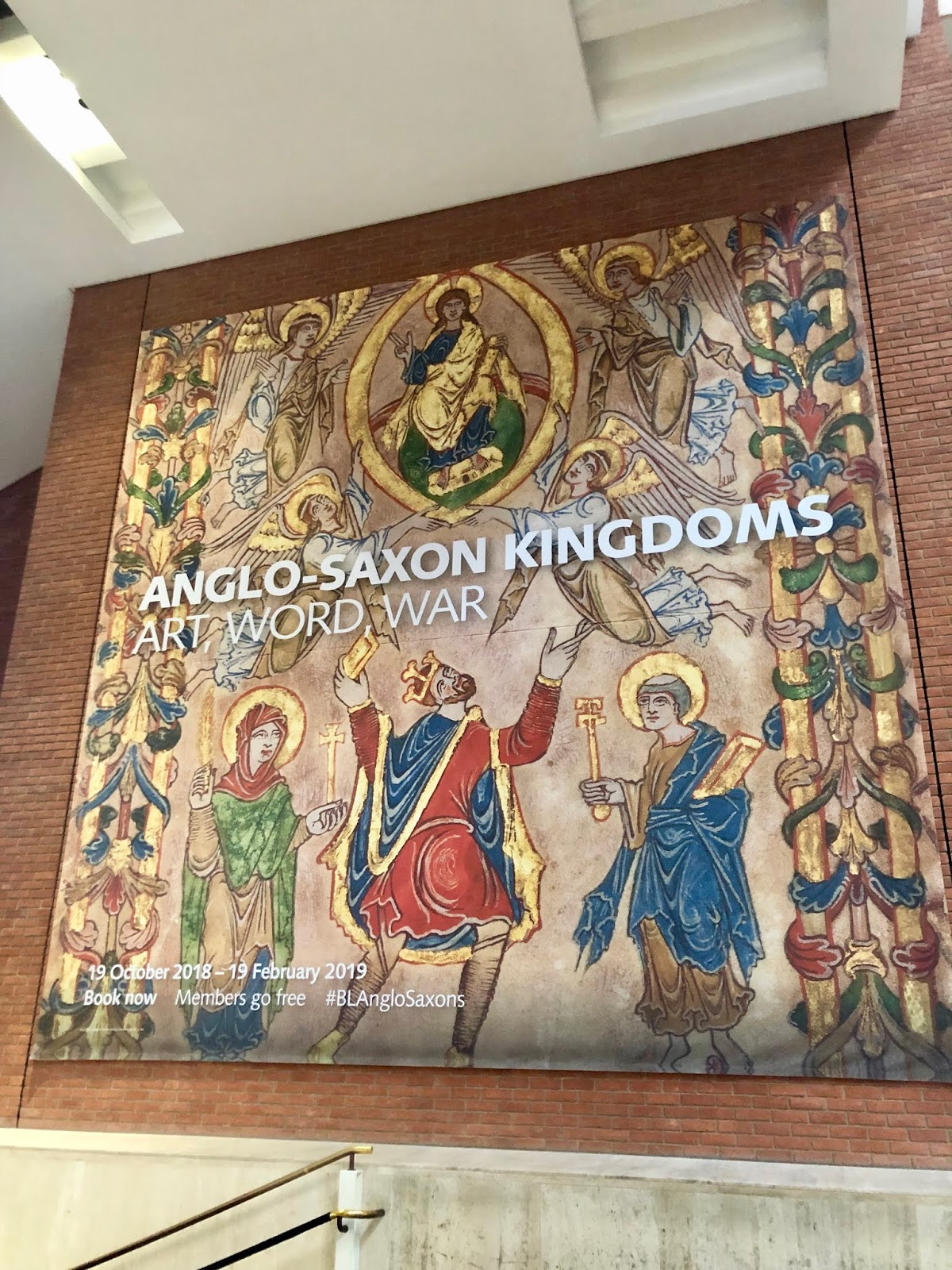
The British Library has had an Anglo-Saxon Kingdoms exhibition on display since October which I had been very much wanting to see. Time was beginning to run out as the exhibition ends next month, so on Thursday I took myself off to London to see it. Our trains to London run into a station handily placed just a five minute walk from the British Library, so I can be there in about an hour, door to door. My plan was to see the Anglo-Saxon exhibition in the morning, then to get lunch at either the British Library or the British Museum, and to go to the exhibition on Ashurbanipal and the Assyrians currently on at the British Museum in the afternoon if I had time. In fact the Anglo-Saxons exhibition took me so long to absorb that I ended up just having a quick wander round the free gallery at the British Library in the afternoon before heading home. Ashurbanipal will have to wait for another day - I do hope to make it though, as Ashurbanipal's library is one of my favourite exhibits at the British Museum and I would very much like to know more about him.


I was vaguely aware that the exhibition was an important one with much of the most important Anglo-Saxon material in the world brought together for the first time. I didn't buy a catalogue so working from memory here, but the list of items on display was pretty extraordinary. In no particular order it included:
  • The earliest surviving copy of Bede's Ecclesiastical History
  • Codex Amiatinus, the oldest complete Latin Bible (written on parchment so enormous, maybe 12 inches thick?) - made in England but now in Italy
  • The oldest copy of the Rule of St. Benedict
  • The Lindisfarne Gospels
  • The earliest copy of the Anglo-Saxon Chronicle
  • The earliest surviving letter in English
  • The agreement between Alfred and Guthrum which established the Dane-law
  • Domesday Book
These are just the tip of the iceberg - other items that I particularly liked were an Anglo-Saxon world map, a book personally annotated by both Saint Boniface and Saint Dunstan, and a beautifully illustrated herbal describing the uses of various plants (parsley for snake bites, apparently). There were also some artefacts on loan from museums, including sword embellishments from Sutton Hoo, part of the Staffordshire Hoard, and the Alfred Jewel (up there with Ashurbanipal's library as one of my all time favourite museum exhibits). Photography was not allowed, but here is a picture I took last year of the Alfred Jewel in its usual home, the Ashmolean Museum in Oxford.


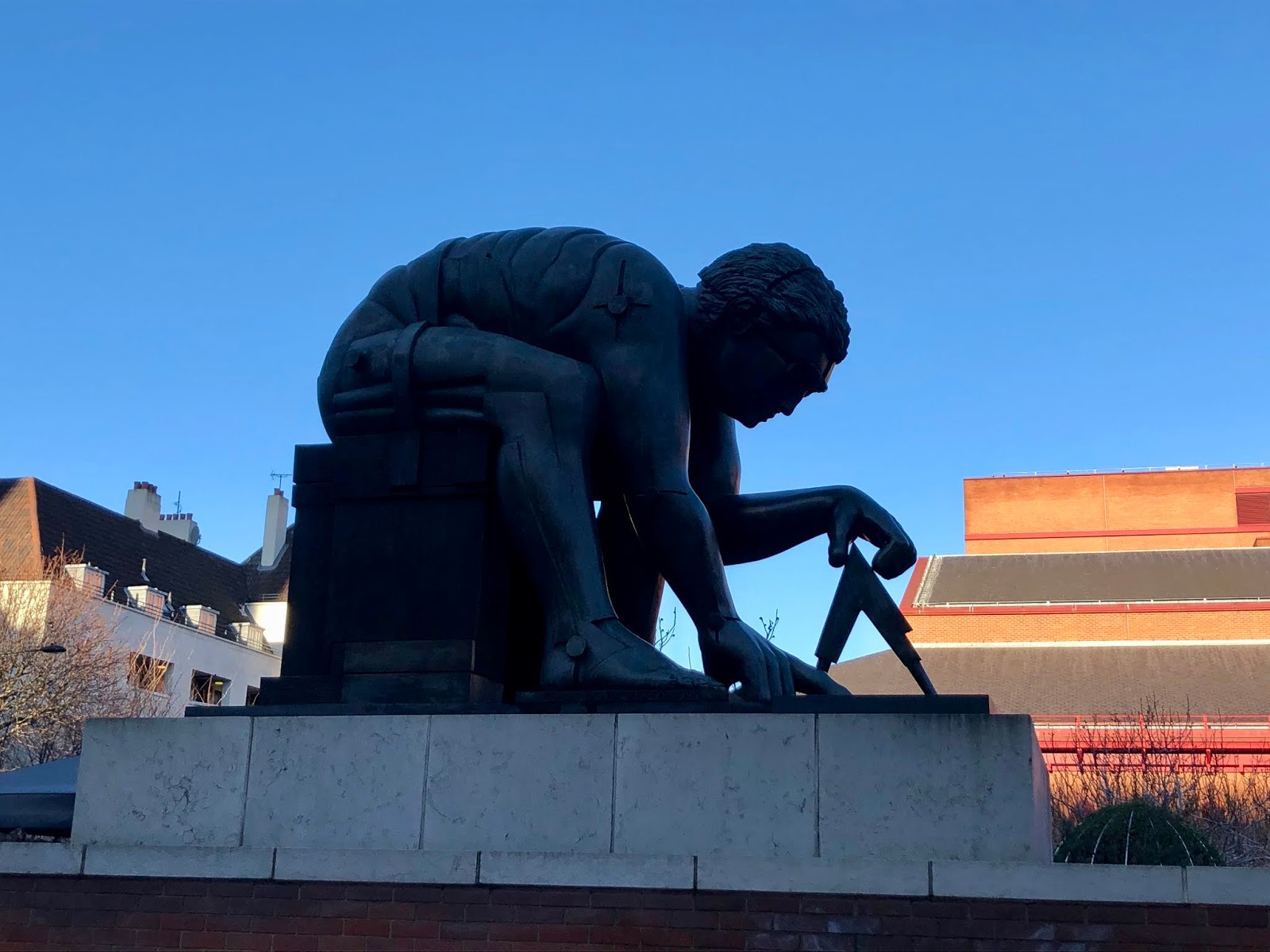
I have also added a couple of pictures from outside the British Library: a giant statue of Isaac Newton in the forecourt (above), and the roofline of St. Pancras railway station behind the modern library building. It was a beautiful, bright (but cold!) morning, with a perfectly clear blue sky.


The British Library has various articles and featured items from the exhibition on its website here.