Showing posts with label history. Show all posts

Sunday, 27 June 2021

The Cotswolds: Day 1

Over the last month we have done a lot of playing catch up with things that had been postponed due to lock down. The last of them - I think! - was a night away, using a gift voucher that R gave for Christmas 2019. Yes, that long ago!  The arrangements turned into something of a saga. We decided we would like to go to the Cotswolds - not too far from home, so no long drive, but always lovely. The first hotel we booked cancelled as they had double booked. We rebooked into a Holiday Inn near Warwick, then on Thursday night decided to look at Trip Advisor reviews. It was a good thing we did, not because there were bad reviews, but because there was a review posted the previous day complaining that a booking had been cancelled because the hotel was being used as a quarantine hotel for people flying in from red list countries. M phoned and the hotel verified this. It also turned out they did not have any record of our booking. Oops! We had booked through the voucher company, and something clearly went very wrong. 

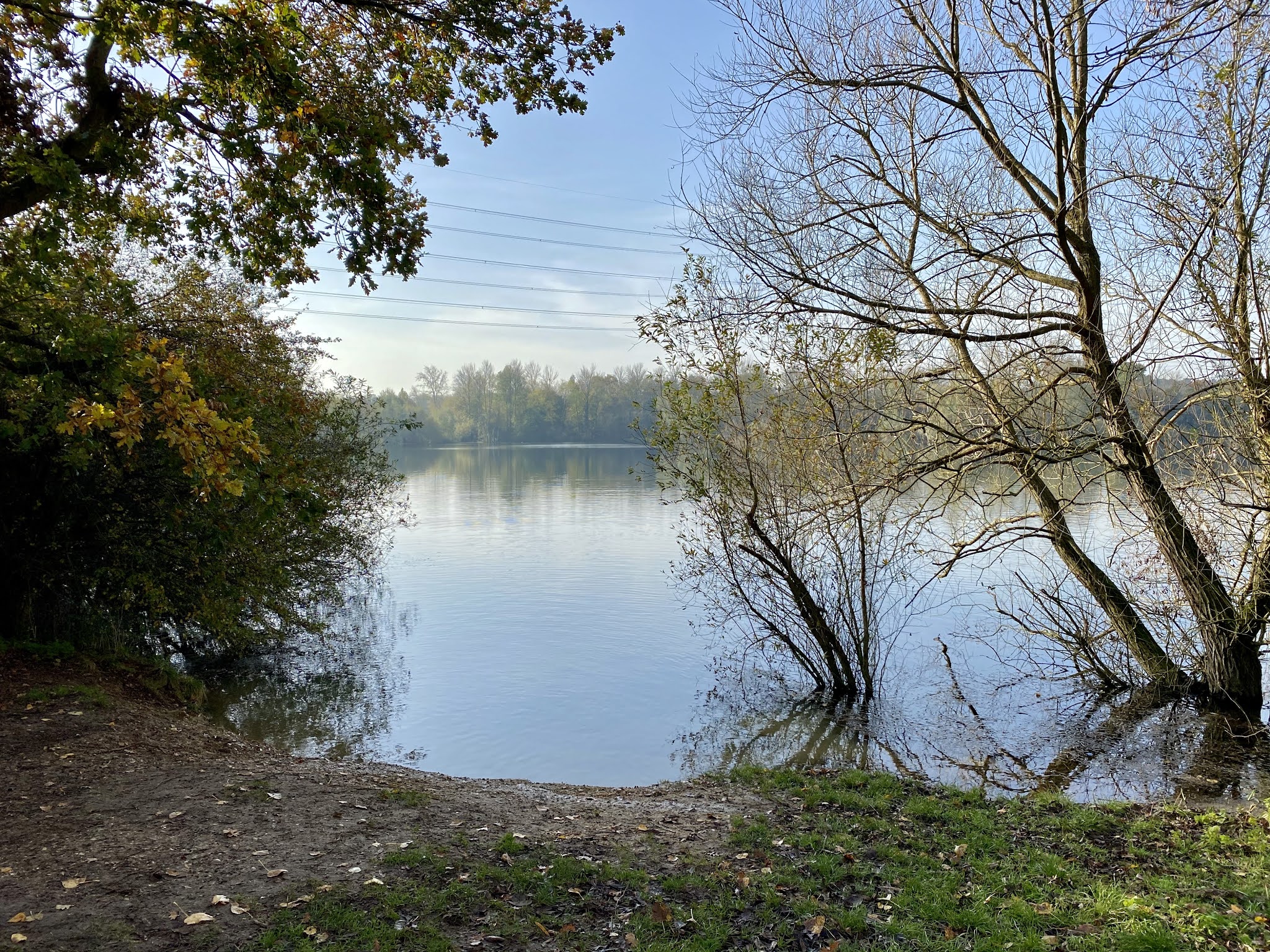
We decided that as we had already arranged for R to have TG to stay overnight on Friday we would make a last minute booking of our own and then try to unravel the voucher mess later, and booked in to a hotel in Banbury, about an hour's drive from home. We stopped off on the way for a wander around the town of Brackley, where we found a nice park with a lake and a group of geese pretending to be statues - we had to watch closely to spot any of them moving! After that we headed for Upton House, a National Trust property about 15 minutes the other side of Banbury. We had lunch in the cafe before exploring the house and grounds. 

It was bought in the 1920s by the owner of the Shell oil company, who decorated it in Arts and Crafts style, filled it with collections of art and china and bequeathed it to the National Trust in his will, with the provision that it should be left as it was so that the public could share his own enjoyment in the house and its contents. 


After puttering around the garden we went back to the cafe. Fortified with tea/coffee and cake we then went for a walk in the local countryside. Most National Trust properties have suggested local walks of various lengths - this time we picked the shortest as it was already mid-afternoon and the car park closed at 5.30. The highlight was this view from an escarpment looking over the site of the Battle of Edge Hill (the first major battle in the Civil War between Royalists and Parliamentarians, which took place in 1642). Apparently on a clear day it is possible to see 40 miles across to the Malvern Hills. 
 

After our walk we headed to Banbury and dinner at our hotel, which was originally an inn built in the 17th century, now much extended but still with the old inn at its centre. The hotel has quite a history. King James II stayed there in 1687, and Jonathan Swift stayed there while writing Gulliver's Travels - he took the name of Gulliver from a tombstone at the church on the opposite side of the road. Also one of the rooms was used as a secret meeting place for Catholic priests during penal times.  

We packed quite a lot into Saturday, so I'll put that into another post. In other news all our young folk have now had their first dose of Covid vaccines, except TG who is too young as the UK is currently only vaccinating over 18s. R and H and R's boyfriend all had Moderna, which hasn't been widely available in the UK until recently, and H's boyfriend had Pfizer. H came over this evening to watch the new Disney movie Luca with us. It is set on the Ligurian coast of Italy, where H spent her year abroad in 2018/19, so that was quite fun, although as it was an animated movie with a fictional location we didn't exactly recognise anywhere! It did mention H's university city of Genova though. She brought strawberries and chocolate with her, and we have concluded that strawberries with melted chocolate may be the ultimate movie snack!

Saturday, 12 June 2021

A Prehistoric Day: Part 2

So, Stonehenge. While numbers are limited tickets have to be booked for a half hour entry time slot, and mine was 2 to 2.30pm. There is a large, relatively new visitor centre (opened in 2013), with a permanent exhibition, shop, cafe and reproduction late neolithic houses. When I arrived it was raining slightly, so I decided to visit the indoor exhibition first. As well as the permanent exhibition on the history of the henge and the other prehistoric features in the landscape (lots of barrows, mostly of later date than the stones), there was an exhibition of photographs sent in by members of the public showing people enjoying visits to Stonehenge over the decades. Until 1978 there was open access to the stones - I remember playing on and around them when I visited as a child - but the sheer number of visitors meant that for their protection they had to be roped off. 


The visitor centre is more than a mile away from the henge, with a shuttle bus service available. I decided to do the 30 minute walk, to get more of a sense of the landscape. It had stopped raining, but there was still some ominous looking cloud when I reached the stones. Fortunately it cleared while I was there and the sun had come out by the time I left. 

It seems almost certain that the point of Stonehenge was to allow celebrations of the summer and winter solstices. The single stone in the picture above is the heel stone, which points directly through a gap in the centre of the henge to the setting sun on the winter solstice. Looking the other way, at the summer solstice the sun rises behind the heel stone. 

To help with social distancing there is currently a one way system leading clockwise around the circle of stones. When I reached the opposite point I managed to get a photo pointing exactly towards the summer solstice sunrise. The tall stone with the bump on the top is the remaining upright of the central trilothon inside the outer circle. Its partner and the lintel have both fallen, but the line leading through what was the  centre of this trilothon to the heel stone (which you can see in the distance just to the right of the upright) formed the axis along which the solstice sun rises and sets. 


English Heritage has put together a good audio tour of the stones, the exhibition and the landscape, available as a phone app.  I had downloaded the app before I went and took AirPods with me so that I could listen as I walked around. One thing I learned is that the back is scruffier than the front. The builders were very careful to make the front of the henge smart, but were more careless about the back and put less effort into cutting the stones smoothly.  

At the end of the circuit of the stones I sat on a bench for a while, enjoying the sun and the view. According to my Watch I had walked 7.5 miles by then and my legs decided they didn't fancy walking back so I took the shuttle bus back to the visitor centre. I bought myself a couple of pencils and a key ring in the shop as useful souvenirs and fuelled up on coffee before heading home. I possibly had just enough juice left in the car battery to make it home, but decided to make a quick charging stop at nearby Amesbury just to be on the safe side. A ten minute top up was all it needed and I made it home in just over 2 hours. Such a treat of a day, rounding off a busy but very enjoyable couple of weeks. Five months of lockdown, and now it seems as though everything is happening at once! 

A Prehistoric Day: Part 1

Way back in December I booked to visit Stonehenge, but had to cancel the trip when we went back into lockdown. Yesterday I finally made the trip, six months late! With hindsight, the delay was a good thing. I have read more about prehistoric Britain, so was more clued up about what I was seeing, the weather was a lot better, and I was able to drive in daylight. I went on my own, as M is not interested in the history and going alone meant I could explore at my own pace without worrying about him being bored! 

I decided that if I got an early start I would have time to explore the prehistoric landscape at Avebury in the morning and Stonehenge in the afternoon. It took me 2 hours to drive to Avebury and I arrived just before 10. I remember going there as a child, stopping off for a break when we drove to Cornwall to visit relatives, but I don't think I have been there since. The whole area is a UNESCO world heritage site, with good reason. Avebury itself is a small village built both around and amongst the remains of the stone circle, which is the largest in the world. Many of the stones are missing - some were broken up to use as building stone for the village - but many have been replaced by concrete posts, to give an idea of where they would have been. The perimeter stones are huge, dwarfing anybody who stands next to them - I should think maybe 15 feet tall? 

The stone circle has an out ring of tall stones, with two smaller circular henges within it, all surrounded by a ditch and bank earthwork. It was built around 2850BC, and added to and altered over the next 600 years. An avenue of stones joined it to another area known as the Sanctuary, which is even older. 


After exploring the stone circle I walked down the avenue, though not as far as the Sanctuary - I didn't have time to do everything in a single day. Part way along I turned right, walked over a hill and towards another of the area's spectacular prehistoric features - Silbury Hill. This man made mound was built around 2400BC, over a period of about 120 years. It is estimated to have taken 4 million man hours to create, and to have needed about half a million tons of material (mostly chalk). Nobody really knows why it was built. It wasn't a burial chamber and there is no obvious purpose. It was clearly a communal effort involving people over several generations and from many locations - maybe that in itself was a large part of the point of it? 


The National Trust owns this land and much of it is now wildflower meadow, which judging by the amount of birdsong was home to a lot of skylarks. Even without the historic surroundings it would have been a lovely walk. I didn't go all the way Silbury Hill, but turned left and walked along the hedge in the photo above, heading for the other site I very much wanted to visit - West Kennet Long Barrow. Again, I have hazy memories of visiting as a child, but had not been back since. (Rather oddly, although I remember the stone circle and West Kennet, I have no memory at all of Silbury Hill, which is very prominently visible from the long barrow). 


To say this place was worth the walk is an understatement. Built around 3650BC, it is a thousand years older than the Great Pyramid. About 50 people were buried there, in small chambers just inside the entrance - most of the barrow itself is simply an earthwork. The stones at the end hide a small courtyard in front of the entrance. 


The barrow took my breath away. Cold, old, quiet stone. Even after all this time entering feels an intrusion. I met people coming and going along the path, but was alone when I went in. I didn't have a sense of anything fearful about it, just a sense of awe. 


A couple of small sky lights have been put into the roof, otherwise it would be dangerously dark away from the entrance. The chambers were hard to see in the dim light, but the camera on my phone showed me the detail - the picture below shows the only chamber that had a central stone. I loved that in a couple of places people had left bunches of wildflowers. 

When I left the barrow I walked back to Avebury in search of lunch.from the National Trust cafe before heading for Stonehenge ... I'll write about that tomorrow. 

Saturday, 29 May 2021

Expedition to the British Museum

Back in January I wrote a list of things I hoped to be able to do this year. One of them was to visit the Thomas Becket Exhibition that the British Museum had planned for this spring. Museums were allowed to reopen on May 17th following the long lockdown and the exhibition opened a few days later, so I decided to hop on a train and go. The British Museum is an easy trip for me, as it is only 15 minutes walk from Euston Station where the trains from our local station terminate, and the train journey only takes about 30 to 40 minutes. 


As numbers are restricted to allow for social distancing, I had to book tickets both for the exhibition (paid) and general museum entrance (free). I got there with plenty of time to spare, so sat in Russell Square gardens to eat my lunch and enjoy the sun (at last!), then headed over the museum for my 12.30 entrance slot. There was quite a queue for bag checks, which has been moved to a tent outside the museum, but exhibition ticket holders had a separate entrance with no queue. 


I love the Great Court inside the museum, with its cantilevered glass roof and the old British Library Reading Room in the centre. In my postgraduate days the British Library was still within the British Museum and I was able to spend time working in the old Reading Room, which I loved - history just oozed from every corner. The new British library is also a great place to work and far more practical but, well ... new just isn't the same! Still, the Great Court does go some way to making up for the loss of the Reading Room. 


I scooted past lots of ancient sculpture (with a slight pause to admire some Ancient Egyptian statues and the Rosetta Stone) as I wanted to spend some time looking at the Anglo-Saxon and prehistoric Europe galleries. Over the past few months I have got interested in prehistoric Britain, about which I previously knew almost nothing, and I am currently reading a new book on Anglo-Saxon England, so wanted to indulge those interests. The photo above is a reconstructed helmet from the Sutton Hoo ship burial, which is now believed to have been the burial mound of Raedwald, king of the East Angles, who died in the early 7th century. 


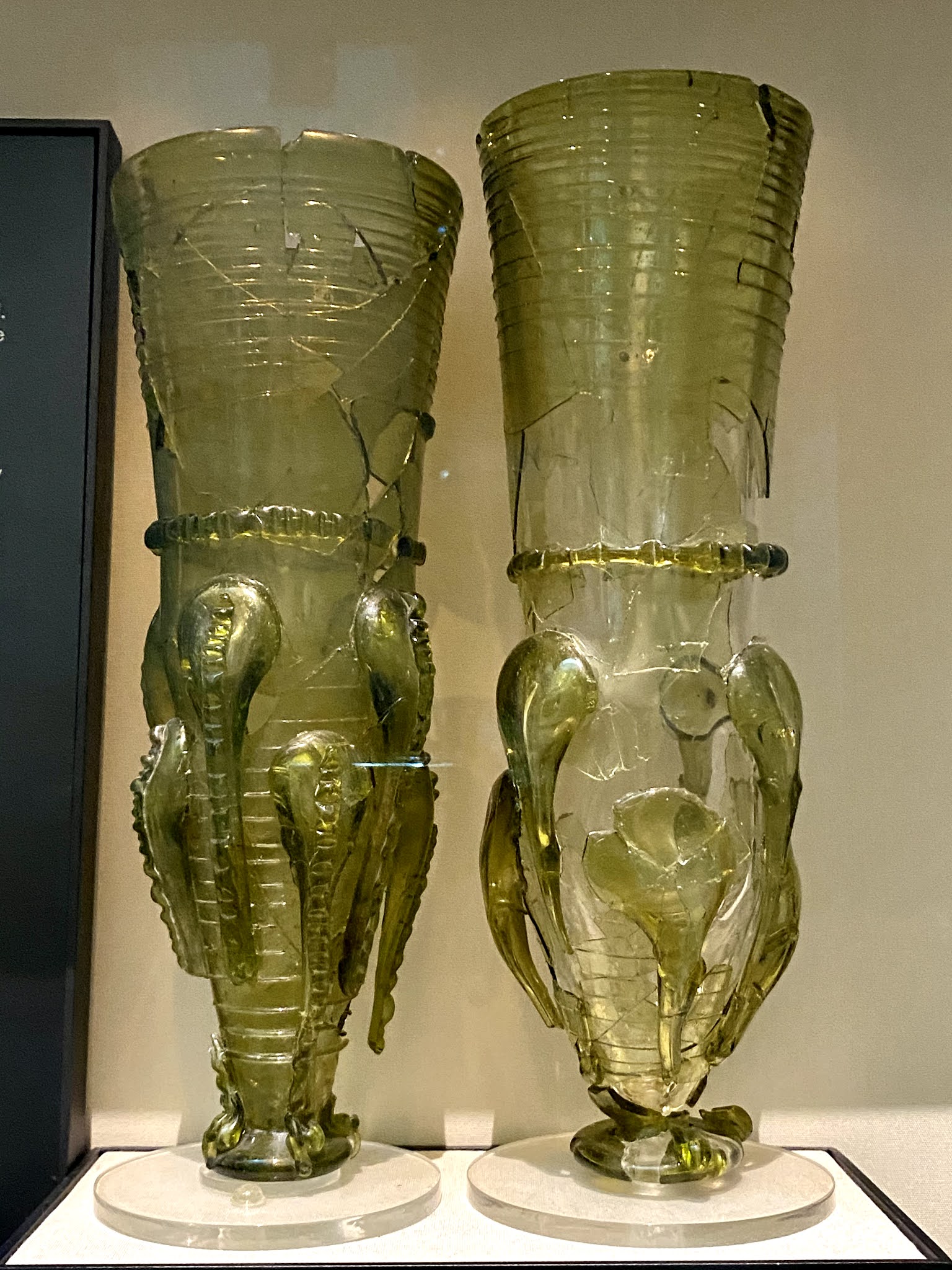
I rather liked these two Anglo-Saxon drinking glasses, also from an early 7th century burial, this time in Buckinghamshire. After the Anglo-Saxons I worked backwards through Iron and Bronze Ages back to Neolithic times. The picture below shows items from an Iron Age grave of the 1st century BC, which have been displayed in the positions they were found.  


I think the two axe heads on the left of the picture below were perhaps my favourite items in this gallery. They date from 4000BC and are made from jade quarried in the Italian alps. They were high value, high status ornamental items, too delicate for use as tools, beautifully shaped and highly polished. 


I had just the right amount of time to get round the things I wanted to see before my entry time for the Thomas Becket exhibition. When I was a student I took a course on King Henry II with a scholar who was an expert on Becket, so I had quite a bit of background knowledge already. The joy of an exhibition like this is that items are borrowed from many other museums, archives and individuals and can be seen together. 


The beautiful casket above is a medieval reliquary, with pictures telling the story of Thomas Becket. Below is the only surviving document with Becket's own seal, on which he calls himself  Thomas of London. 


There were quite a number of illuminated manuscripts, some telling Becket's story and at least a couple of books that he had owned. 


In one section there was a series of replicas of stained glass windows from Canterbury Cathedral showing scenes from miracles said to have taken place at Becket's shrine. 


An unexpected treat was an original copy of the 1225 version of Magna Carta, one of only four which survive. The original 1215 version of the Charter didn't "stick" - King John abrogated it soon after it was agreed and had it nullified by the Pope. An amended version was agreed in 1216 after John's death, and this was revised again in 1217 before the final version was agreed in 1225 - so this one is in effect THE Magna Carta.

I could have included a lot more photos, but this post is already rather picture heavy! By the time I had finished looking at the exhibition I was tired from standing mostly still looking at things (why is standing often more tiring than walking?) and was ready to go outside and take off my face mask, so I headed home. On the way back to the station I stopped at a stall for coffee and a vanilla bun and sat in another garden / park area to enjoy a bit more sun. When I got back M had walked down to meet me and we walked back from the station together. After all the pandemic restrictions I now truly appreciate being able to go out and do something like this - something that I would have taken for granted before. 

Monday, 3 May 2021

Cold, Wet and Windy - Is It Really May?

It is hard to believe we are into May as the weather feels more like the beginning of March, far too chilly for this time of year. At least it was dry yesterday morning so we went for a walk on Dunstable Downs for the first time this year. We did a tiring four mile circuit along the top of the Downs - going down is OK, getting back up again is hard work! 

The first part of the walk was along the ancient Icknield Way. I am trying to learn more about ancient British history and have been reading Home by Francis Prior, a history of domestic life from the Mesolithic to the Iron Age. At one end of the Downs is a set of seven round barrows known (confusingly!) as Five Knolls. These date back to the Bronze Age, possibly as far back as 2500 BC. The picture below shows the path which crosses the three barrows at the southern end of the site. 

In the afternoon I watched Thor with TG, then cooked a large roast dinner for which H and M2 joined us.  They seem to be doing well and are very happy with their new house. Poor TG has had a nasty sniffly cold over the weekend and had to miss a dance class on Saturday, but she has now pretty much shaken it off. Although today was a bank holiday M had to work this morning, while TG and I stayed home and were lazy apart from a quick trip to the supermarket. 

This afternoon we had arranged to go over to R's for a BBQ, along with H and M2. Unfortunately the weather did not cooperate. We did manage to cook outside on the grill, despite a strong wind, but then it started to rain heavily and there was no choice but to eat inside. Under the current coronavirus restrictions mixing indoors isn't allowed, but it is clear that in two weeks time it will be. Given that M and I are vaccinated and local Covid rates are very low, it felt safe enough. While R was cooking I managed to distract R and M3's dog from the smell of sausages for long enough to get a photo of him sitting still and looking every inch the beautiful beagle. After we ate we played scattergories -there may have been a few disputes over the acceptability of answers! Despite the weather it has been a good weekend. One positive thing about the pandemic is that it has made us truly appreciate how good it is to be able to spend time with family, rather than taking it for granted. 

Wednesday, 7 April 2021

In Memoriam

I had a productive morning today. I read for a while, then sorted out my tax return for last year. As the tax year ends on the 5th April, getting the return submitted on the 7th was impressively good going, I thought. For once I even got mine done before super-efficient M. To be fair, it is straightforward enough - I keep a running total of freelance income for the year and the employed income figure was on my last pay slip - but it still somehow seems to take more mental energy than it deserves. Being able to complete and submit the return online makes it much easier in my opinion, though M disagrees and is much happier filling in the paper form. Each to their own! HMRC now owe me a refund for overpaid tax on account, so it was a particularly satisfactory exercise. To celebrate TG and I watched the first part of Harry Potter and the Deathly Hallows; we then watched the second part this evening, completing our Harry Potter movie binge. 


This afternoon M and I went to Stowe Gardens for the first time since before the lockdown and did a 5 mile walk around the grounds. The Friends of Stowe House had a little takeaway cafe open just behind these steps, and we tried to resist but failed. We ended up sitting on the steps sharing a scone with jam and cream and warming up with a cup of tea. The snow had gone but it was still definitely on the chilly side. I'll post more photos later in the week. For now I want to talk about this one ... 

M decided to participate in a yellow candle project to remember individual victims of the Holocaust on Yom HaShoah (Holocaust Remembrance Day) which falls on April 7th. Everyone taking part was sent the name of someone who perished along with a candle to light in remembrance of that individual. The name he received was a little girl who died in the Minsk Ghetto, Lyuba Konatopski. I put my research skills to work and was able to discover that she died along with her older sister Vera and her mother Sonya. Her brother, and possibly her father, survived. There are multiple records for her on the Yad Vashem list of Holocaust victims, and it seems more likely that she was born in 1938 and died in 1941, so was actually only three years old when she died, not six as it says on the card. After the Germans captured Minsk, the capital of what was then the Belorussian Soviet Socialist Republic, in the summer of 1941, a total of over 80,000 people were confined to the Ghetto, where they were subjected to repeated killing raids. It seems likely that Lyuba and her family died in one of the earlier massacres. Minsk now has a memorial to its lost Jewish citizens on the site where 5000 people (including many children) were shot in March 1942. 

May her soul, and the souls of her mother and sister, rest in peace. 

Saturday, 3 April 2021

Running on Empty

Today has been one of those days where I have been battling low energy levels, despite sleeping very well for the last two nights. I think I still haven't really caught up from a run of short nights before that, probably because I was subconsciously anxious about H's house move. Since I was ill last year, lack of sleep very quickly translates into lack of energy and feeling generally under the weather, and I often find it hard to know whether it is better to push myself to keep moving, or to slump in a heap on the sofa. Today I had booked an online yoga class for 9.30, so I started my day with that, occasionally opting out for a bit to lie on the mat or the sofa in a tired and grumpy heap. It felt as though my personal battery had run flat. 


After yoga I cut M's hair. I bought hair clippers just before the first lockdown started last year, which proved to be a very good call. H took on the task of hairdresser to start with, but once she got busy with work I took over clipping M's hair, though she has still been trimming mine for me. I read for a while, then made myself vegan cauliflower "cheese" for lunch - I am trying to get plenty of veggies in, and also to go back to eating mostly plant-based as I suspect that for me eating animal products contributes to stiff joints and muscles. After lunch H came round to use our internet as she still doesn't have any - she had various calls to make and things she needed to do online. M and I went out for a shortish walk, which I felt I should make the effort for even though I was still tired from the yoga class. I started off tired and grumpy, but (fortunately for M) the fresh air perked me up. When we got back I went out again, this time to the supermarket to pick up a few bits, including bread as passover is coming to an end. TG and I then watched the next Harry Potter movie, with a break to cook dinner - burgers (vegan for me, meat for M and TG), sweet potato wedges and sweetcorn. 


The photos are from a walk we went on a few days ago, which was a route we hadn't taken before. The archaeology report I am reading had some useful maps showing the historic boundary of our parish, which was described in detail in a 10th century charter. I wanted to walk a section of this ancient route which formed the southern boundary. The path in the top photo now runs alongside the road running round the outside of our housing estate, though separated from it by a hedge, and the lane in the bottom picture is the driveway for a farm. We won't repeat the walk as it involved crossing three very busy roads, but it satisfied my urge to walk in the footsteps of people who lived over 1000 years ago. 

Friday, 27 November 2020

Staying Home Part 2: Day 23

It was another foggy, murky day today. So foggy I decided to drive through town to take TG to school, but then regretted it because of the traffic. Taking yesterday morning off for a walk was definitely the right call. M went for a short walk this afternoon but I opted out because it looked so miserable, and in any case I had work to finish and was very tired. I haven't slept well this week - I have been going to sleep far too late and then been woken too early by the alarm - and it caught up on me today. My brain was in the same foggy state as the weather. I have decided I need to find a better night time routine so that I go to sleep earlier. 

I have organised a pre-Christmas day out for myself. Reading about neolithic Britain gave me a yearning to visit Stonehenge. It must be nearly 40 years since I last went there. We used to visit quite often when I was a child, because we had relatives in Cornwall and the route passed nearby, making a it a good stopping off point. In those days the site was pretty much unrestricted. I have a feeling there wasn't even an entrance fee. The stones were not fenced off and visitors could wander around freely. These days a combination of its popularity with tourists and awareness of the need for conservation mean that the stones themselves are fenced off and it is only possible to walk round the outside - though still with a good view, I think. There is also a large visitor centre which is new since I last went, over a mile away from the stones so that it doesn't spoil the open aspect of the site. 

So, once I got Stonehenge in my mind, I decided I should organise myself to visit. M really isn't interested, and although he would have come with me as company, we both decided I would enjoy it more on my own so I can potter at my own pace and not worry about him getting bored. Last night I booked myself a ticket, for the afternoon of December 21st - the winter solstice. From the reading I have been doing it seems that the latest thinking on Stonehenge is that it was deliberately built to align with the setting sun on the winter solstice (it also aligns from the other direction with the rising sun on the summer solstice and it used to be thought this was the point, but other evidence now suggests the winter alignment was more important), so I will actually get to see the henge at the very time it was designed for. 

I was slightly surprised that there were tickets available. I know Druids, pagans and so on gather to see the summer solstice sunrise at Stonehenge, and I assumed that the winter solstice sunset would also be popular, but it seems that what interests them is the sunrise rather than the sunset. The usual winter solstice morning event can't be held because of the pandemic, so the sunrise is being live streamed and people asked not to visit, but there was no probably getting a ticket for the afternoon. Whether there will be many people there, I don't know, but ticket numbers will be limited anyway because of Covid. My plan is to drive down to Wiltshire in the morning (it is about 2 hours away) and visit the stone circle at Avebury in the morning, then to stop somewhere to get some lunch and a bit of electrical juice for the car before getting to Stonehenge for my 2pm entry slot. Sunset is just before 4pm, so the timing should work out perfectly As a bonus, when I went to buy a ticket, I discovered that although the site is run by English Heritage, of which I am not a member, it is owned by the National Trust, and I could get a free ticket using my National Trust membership. 

No photos today, so I have added some from Mayburgh Henge near Penrith, another Neolithic site we visited when we were in Cumbria last month.  I am feeling very excited about Neolithic things! 

Monday, 9 November 2020

Staying Home Part 2: Day 5

Not much to say about today as it has just been a busy work day for everyone. H had another exam this afternoon and thought it went OK. TG was at school, and both M and I had a lot to get through. I did some yoga before taking TG to school this morning but we didn't get a proper walk in - partly because I had too much to do and partly because the weather was miserable this afternoon. We did walk up to Tesco Express after I finished as we had run out of toothpaste. Always something! I cooked potatoes, mushroom and salmon from last week's fish box for dinner, roasted together in the oven, and then watched Elf (an old  favourite) on DVD with the girls. I'm afraid I long ago gave up any attempt to avoid Christmassy things until December -  with H and TG egging each other on it is a lost cause. Usually we start doing fun seasonal things in mid-November, with a trip to Birmingham for a gift fair at the National Exhibition Centre, the German Christmas market in the city centre, and ice skating. That can't happen this year, but I think there may be a lot of Christmas movies on the agenda during this second lockdown.

As I didn't take any photos today, here is a bit of local industrial heritage from our walk on Saturday. These little narrow gauge railway tracks were used by carts bringing sand from local quarries to the canal so that they could be loaded on to barges. Sand was a big industry here, and there are still working sand quarries though many are no longer in use. The lake in the photo below is actually manmade, and was originally a disused pit which has been turned into a waterside park. Another old quarry is often used as a movie and TV film set, and a three mile section of narrow gauge track is now run as a heritage railway.  

For some reason I keep forgetting to mention here what I am reading. I am mostly in a non-fiction mood at the moment. I asked for a  English Pastoral by James Rebanks for my birthday, which is about farming past, present and future on his Lake District family farm. Although their farm is in a very different part of the country, the farming methods his grandfather taught him were very similar to the way my father worked the farm where we lived until the mid-1970s, so that section was a trip down memory lane. The middle section, as he describes how industrial farming took over, stripping the land and plunging farmers into a debt as they borrowed to buy better machinery, fertilisers, weed killers and so on, was predictably depressing, but it was wonderful to hear how he - along with many other farmers - is now working to restore his land and to find ways to farm in harmony with it. 

I am also half way through a biography of 19th century Quaker prison reformer, Elizabeth Fry, along with Neil Oliver's History of Ancient Britain. I can only read the Elizabeth Fry book on my Kindle, and can't close it down until it is finished as I borrowed it on Kindle Unlimited but have now cancelled my subscription (I tend to subscribe for a month or two at a time when I find books available on it that I want to read). I often read on my laptop because the larger screen makes it easier to knit and read at the same time, so have the Neil Oliver book open on that. I recently finished listening to a book on Audible about British Prime Ministers from Ted Heath in the early 1970s through to Theresa May, and have just started listening to The Frayed Atlantic Edge, in which historian David Gange kayaks along the Atlantic coast from Shetland around Ireland to Cornwall. Books about walking, journeying and landscape are a bit of a reading theme for me at the moment. 

Thursday, 6 August 2020

Thursday: Roman London and Electric Cars


Two completely unconnected things that have been on my mind this week are Roman London and electric cars. I decided - a little late in the day! - that I haven't taken enough advantage of all the many things that have been available online since March, so I signed up for a virtual tour of Roman London and a talk about Roman domestic items found in London. Although run by different organisations, I thought the two events would fit well together. The tour on Sunday evening was with Footprints of London, an organisation which in normal times runs guided walking tours, but has now started offering online "tours" for a small charge. Then today I "attended" a talk run by the Layers of London mapping project in which an expert from the Museum of London Archaeology talked about the the connections between domestic items and location. 
I really don't know a great deal about Roman Britain (or Roman London), so I learned quite a bit from both talks - more from the guided tour, I think, which gave me good ideas of places I would like to visit. For example, part of the old Roman wall can be found in London Wall underground car park in Bay 52! One Roman site I have visited is the Mithraeum, which was mentioned in both talks. The remains of the 3rd centuryMithraeum were discovered in the 1950s but were moved to a different site to allow building work to take place. That building was demolished in the early 21st century and the Mithraeum was moved  back to its original site and incorporated into the basement of Bloomberg's newly built European HQ. The Mithraeum and an exhibition of items found on the site is free to visit, but (even in non-Covid times) has to be booked in advance. The pictures on this post are from my visit two years ago. 
The other theme of this week has been electric cars. We have decided the time has come to replace our main car, which now has pretty high mileage and is getting more expensive to maintain. It also runs on diesel, which when we bought it was supposed to be more environmentally friendly than petrol, but is now considered to be the worst fuel to use. Just before everything locked down we had started looking into electric cars, and had more or less decided - with a bit of trepidation - that we would switch to fully electric. As Covid risks now seem relatively low, we booked test drive for two different cars this week. Yesterday we tried out a Nissan Leaf, and today a Kia e-Niro. After trying them both, we decided the e-Niro was the best in terms of looks, feel, range, warranty, and overall quality, but the Leaf was better to drive, cheaper, has more safety tech, and is more comfortable for M who has scoliosis and needs a car that feels right for his back. After lots of discussion, we have settled on the Leaf in a special edition model which has a larger battery than the model we were initially thinking of, and includes various extras that will make it easier and more comfortable to drive. We are hoping we may be able to order one tomorrow.
I am now back to working-at-home on my archives job, and M will be going back to 111 at the weekend - another step back towards a new normal. TG is mainly being very teenage and getting up in time for lunch and binging on Glee. H decided we needed to plant flowers, so we went on a trip to a local garden centre on Tuesday and bought some bedding plants to put in pots round the patio. We had coffee and cake in the cafe while we were there, which again, was a nice bit of normal. Yesterday while M and I were out test-driving the two girls got them all planted and we have sorted out a system which should mean someone remembers to water them. I have black thumbs and the sum total of our gardening knowledge is very, very small, so I am not hopeful that they will survive, but at least we are trying! 

Friday, 5 April 2019

Day Trip to Pompeii

Both H and I had been wanting to visit Pompeii and we decided it was manageable as a day trip from Rome. There are three ways to do this - as part of an organised tour, or independently by train or bus.  Using H's local knowledge from her time in Italy we decided to go with the bus option. She and her student friends regularly use Flixbus, which operates services across Europe. Their buses are comfortable and reliable, plus she gets a student discount. We booked direct from Rome to Pompeii, then a return trip from Naples to Rome. As we didn't know how long we would want to spend at Pompeii we booked our return coach for 8pm, thinking we could explore Naples a bit and eat there before heading back to Rome. Naples and Pompeii are linked by a small Metro-like local train line, which runs regularly and only takes about 30 minutes.


Our bus from Rome took three and a half hours, so we arrived at Pompeii late morning. It was about ten to fifteen minutes walk from the bus stop to the back entrance of the archaeological site. Modern Pompei seemed quite a nice little town, and we stopped off on the walk to Roman Pompeii to buy a gigantic doughnut and almost-as-gigantic savoury pastry to share for our lunch. The gate we used took us into Pompeii near the amphitheatre, at the opposite end of the site to the main entrance. I imagine that in the peak tourist season it would save quite a bit of time by avoiding the hordes of tour groups. As it was we were able to walk straight in - free! 


I had been listening to Professor Mary Beard's Pompeii on Audible so this time I did have some context for what I was seeing. I also read this Pompeii guide she wrote for the Daily Telegraph (I think you have to register to be able read it as a free article on the website), which was incredibly helpful. She advises not getting bogged down trying to identify every building, and to wander as you please and take advantage of serendipity rather than join a guided tour. She suggests six "essential sights" and we decided a good manageable plan would be to focus on finding all of these while stopping off to look at anything else that took our fancy. It very quickly becomes obvious that it is not possible to see everything in one trip. Pompeii is huge. 

We checked off one of our six sights immediately, which was the amphitheatre. The rest took a bit more hunting down. The little fresco below was an early bit of serendipity. Unfortunately I can't remember where I found it, except that it was in a villa, but I thought it was a lovely bit of detail.


The second of our six sights was the Temple of Isis. According to Professor Beard it was visited by Mozart in 1769 and gave him ideas for the Magic Flute.


Another bit of serendipity was this Roman oven in what had been a row of small shops, opposite the pavement where we sat down on a step to eat our lunch.  


After lunch we wandered through the forum and on to the  third of our target sights: the House of the Tragic Poet, best known for its CANE CANEM ("beware of the dog") mosaic. The house itself was not open - or if it was, we didn't manage to find a way in! 


From the House of the Tragic Poet we walked down to the Villa of the Mysteries, which is about as far as it is possible to get from the amphitheatre where we began. This villa is best known for its extraordinary wall paintings.  


After walking back to the forum we got slightly lost trying to find our last two sights. One was the brothel, which attracts far more visitors than it can easily accommodate so has a one way system through the small building. We found the exit easily enough but took a while to find our way round to the entrance. After filing through the brothel (never thought I would find myself typing that!) we looked for the sixth and last place on Professor Beard's list, the Stabian baths. Quite how we struggled to find these I have no idea as the baths are one of the largest buildings in the entire city. They were also only a few yards away from where we ate our lunch.


By this time we were flagging, so we explored the baths and then headed for the train and Naples.  I think we spent about four and a half hours inside the Roman city altogether, which was as much as our legs and brains could handle in one go. It would take many visits to get thoroughly acquainted with Pompeii.

Naples was generally not a success. We made the mistake of trying to walk from the station to the historic city centre. The area round Naples station is grim - very dirty and it felt none too safe. We are quite experienced, street wise travellers and blend in pretty well (H in particular looks Italian), but we were definitely uncomfortable. We should have done a bit more homework and taken the Metro to where we wanted to go. We also got our timing wrong and realised after walking for a while that by the time we got to where we were heading we wouldn't have long there before we needed to set off back to the station area if we wanted to get dinner. In the end we decided to just give up on trying to see anything of Naples and retraced our steps back to the station. The exception to avoiding this area is that there are some cafes and restaurants on the left side of the square in front of the station. We ate in one of these and had the best, proper Neapolitan pizza in a cozy and friendly little restaurant. This went some way to redeeming Naples in our eyes.

It was a long and tiring day - we left our hotel at 7.30 in the morning and didn't get back until 11pm - but absolutely worth it. If you ever get the chance to visit Pompeii, go!